
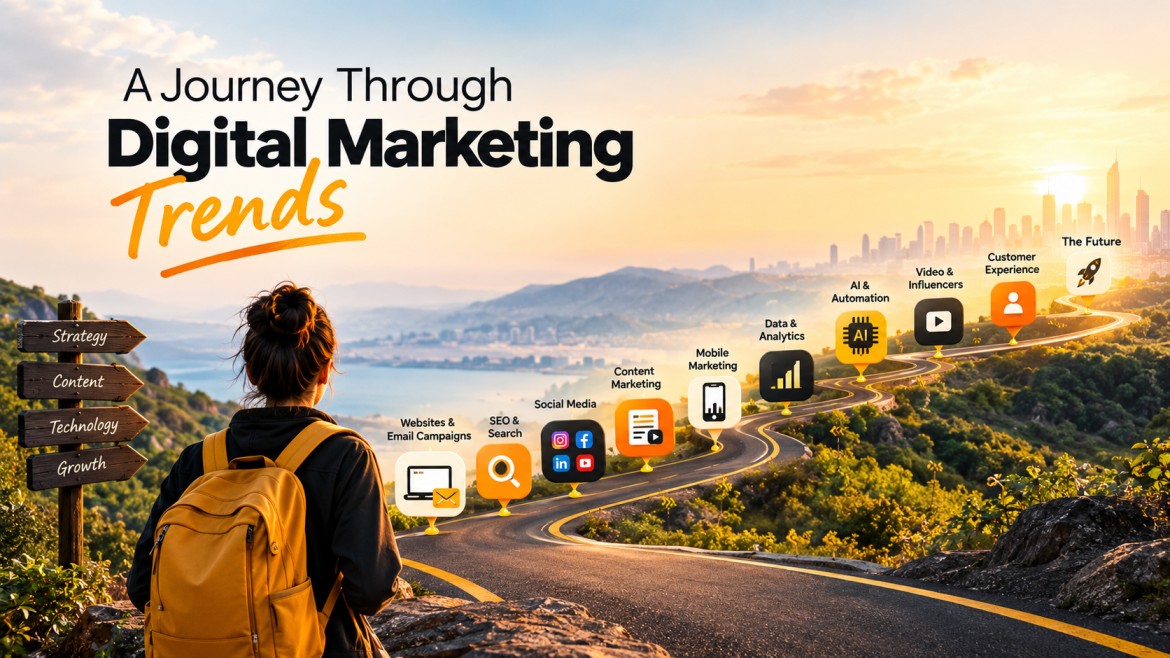
A Journey Through Digital Marketing Trends
Digital marketing has come a long way. From simple websites and email campaigns to social media, artificial intelligence, automation, and personalized experiences, the digital landscape has continuously evolved.
Today, digital marketing is much more than promoting a product or service online. It is about understanding customers, creating meaningful experiences, building trust, and connecting with the right audience through the right channels.
Let’s take a journey through the major digital marketing trends that have shaped the industry and continue to influence its future.
The Beginning of Digital Marketing
The early stage of digital marketing was relatively simple. Businesses began creating websites to establish an online presence, while email became an effective way to communicate with customers.
As more people started using the internet to search for information, products, and services, businesses recognized the importance of appearing in search results.
This led to the growth of Search Engine Optimization (SEO) and online advertising.
Businesses began optimizing their websites and creating online content to attract visitors and turn them into potential customers.
The Rise of Social Media
Social media brought a major change to digital marketing.
Platforms such as Facebook, Instagram, LinkedIn, YouTube, and other social networks created new opportunities for businesses to communicate directly with their audiences.
Marketing became more interactive. Customers could comment on posts, share content, ask questions, leave reviews, and communicate directly with brands.
Social media transformed customers from passive audiences into active participants in a brand’s journey.
For businesses, social media became more than a promotional platform. It became a space for building communities, developing brand identity, understanding customer opinions, and creating long-term relationships.
Content Became the Heart of Marketing
As competition increased online, simply having a website or social media account was no longer enough.
Businesses needed to provide something valuable to their audiences.
This led to the rapid growth of content marketing.
Blogs, videos, guides, infographics, podcasts, case studies, and social media content became important tools for attracting and educating audiences.
The focus gradually shifted from:
“What can we sell?”
to:
“What value can we provide?”
Brands that consistently provide useful and relevant information can build credibility and develop stronger relationships with potential customers.
The Mobile Revolution
The growth of smartphones created another major shift in digital marketing.
People were no longer accessing the internet only through desktop computers. They began searching, shopping, watching videos, communicating, and discovering brands through their mobile devices.
This made mobile-friendly websites, mobile applications, mobile advertising, and short-form video increasingly important.
Today, businesses need to consider how their content and websites appear on smaller screens. A smooth mobile experience can have a significant impact on how customers interact with a brand.
Data-Driven Marketing
Another important stage in the evolution of digital marketing has been the growing importance of data.
Digital platforms allow businesses to understand how people interact with their content and campaigns.
Marketers can monitor metrics such as:
- Website traffic
- Engagement
- Click-through rates
- Leads
- Conversion rates
- Customer acquisition costs
- Return on investment
This information allows businesses to understand what is working and where improvements are needed.
Instead of making decisions based entirely on assumptions, marketers can use data to develop more informed strategies.
Personalization Is Becoming More Important
Customers increasingly expect brands to understand their interests and needs.
This has made personalization an important trend in digital marketing.
Rather than delivering exactly the same message to everyone, businesses can create experiences that are more relevant to different audiences.
Personalized emails, product recommendations, targeted content, and customized customer experiences can help brands communicate more effectively.
The goal is simple: make the customer feel that the message is relevant to them rather than just another generic advertisement.
Artificial Intelligence Is Changing Marketing
One of the biggest developments in modern digital marketing is the growth of Artificial Intelligence (AI).
AI is changing the way marketers research, create, analyze, and communicate.
It can assist with activities such as:
- Content creation
- Data analysis
- Customer insights
- Audience segmentation
- Chatbots
- Campaign optimization
- Predictive analytics
- Marketing automation
AI can help marketers work faster and make better use of large amounts of information.
However, technology does not eliminate the importance of human creativity. Successful marketing still requires ideas, emotional understanding, storytelling, and a clear understanding of the customer.
The future is likely to involve a combination of human creativity and intelligent technology.
Short-Form Video Is Transforming Content
Short-form videos have become a powerful way for brands to capture attention in a limited amount of time.
Quick and engaging videos allow businesses to communicate ideas, showcase products, explain concepts, and connect with audiences in a more dynamic way.
Platforms such as Instagram, YouTube, and TikTok have contributed significantly to the popularity of short-form content.
For marketers, the challenge is not simply to create videos but to create content that can capture attention quickly while providing something valuable to the viewer.
Social Media Is Changing How People Consume Content
Social media has changed the way people discover and interact with brands.
Audiences increasingly expect content that is quick, visually appealing, relevant, and easy to consume.
This has encouraged brands to experiment with different formats, including short videos, stories, live sessions, interactive posts, and user-generated content.
The focus is gradually moving from simply gaining followers to creating meaningful engagement and building communities.
Influencer and Creator Marketing
Consumers often connect strongly with creators and influencers they trust.
As a result, brands are increasingly working with creators to introduce their products and services to specific audiences.
Influencer marketing is also moving beyond celebrities. Micro-influencers and niche creators can provide access to smaller but highly engaged communities.
The key consideration is no longer just the number of followers an influencer has. Relevance, credibility, engagement, and audience quality can be equally important.
The Growth of Marketing Automation
Marketing automation is helping businesses manage repetitive marketing activities more efficiently.
Automation can support activities such as:
- Email campaigns
- Lead nurturing
- Customer segmentation
- Social media scheduling
- Lead scoring
- Follow-ups
- Customer communication
By reducing repetitive manual work, marketing teams can spend more time on strategy, creativity, customer relationships, and campaign improvement.
Automation is therefore becoming an important part of modern marketing operations.
The Importance of Customer Experience
Digital marketing is no longer only about attracting customers. It is also about what happens after they discover a brand.
A customer may interact with a business through a website, social media page, advertisement, chatbot, email, or online store.
Each interaction contributes to the overall customer experience.
Businesses that provide a smooth, consistent, and helpful experience across different digital touchpoints can create stronger relationships and encourage customer loyalty.
What's Next for Digital Marketing?
The digital marketing journey is far from over.
Emerging technologies such as AI, automation, advanced analytics, conversational marketing, immersive experiences, and new digital platforms will continue to influence how businesses communicate with their audiences.
At the same time, customer expectations will continue to evolve.
People will expect brands to be faster, more relevant, more transparent, and more personalized.
But one principle is unlikely to change:
Understanding the customer will always be at the heart of successful marketing.
Technology may change the tools marketers use, but the ability to understand people, solve their problems, and communicate meaningful ideas will remain essential.
Final Thoughts
The journey of digital marketing is a story of continuous transformation.
From basic websites and email campaigns to social media, mobile marketing, data-driven strategies, AI, automation, short-form video, and personalized experiences, every stage has changed the way businesses connect with their audiences.
The future belongs to marketers who are willing to learn, experiment, adapt, and embrace new technologies while keeping the customer at the centre of their strategy.
Digital marketing is not a destination.
It is an ongoing journey — and the next big trend may already be changing the way we connect, communicate, and grow.
Written by Keerthi GK
Digital marketing is a continuous journey of learning, creativity, and innovation. As trends and technologies evolve, staying curious and adapting to change will always be essential for growth.
The future of digital marketing belongs to those who keep learning, dare to innovate, and turn every new trend into an opportunity to create meaningful connections.
Hi, this is a comment.
To get started with moderating, editing, and deleting comments, please visit the Comments screen in the dashboard.
Commenter avatars come from Gravatar.