
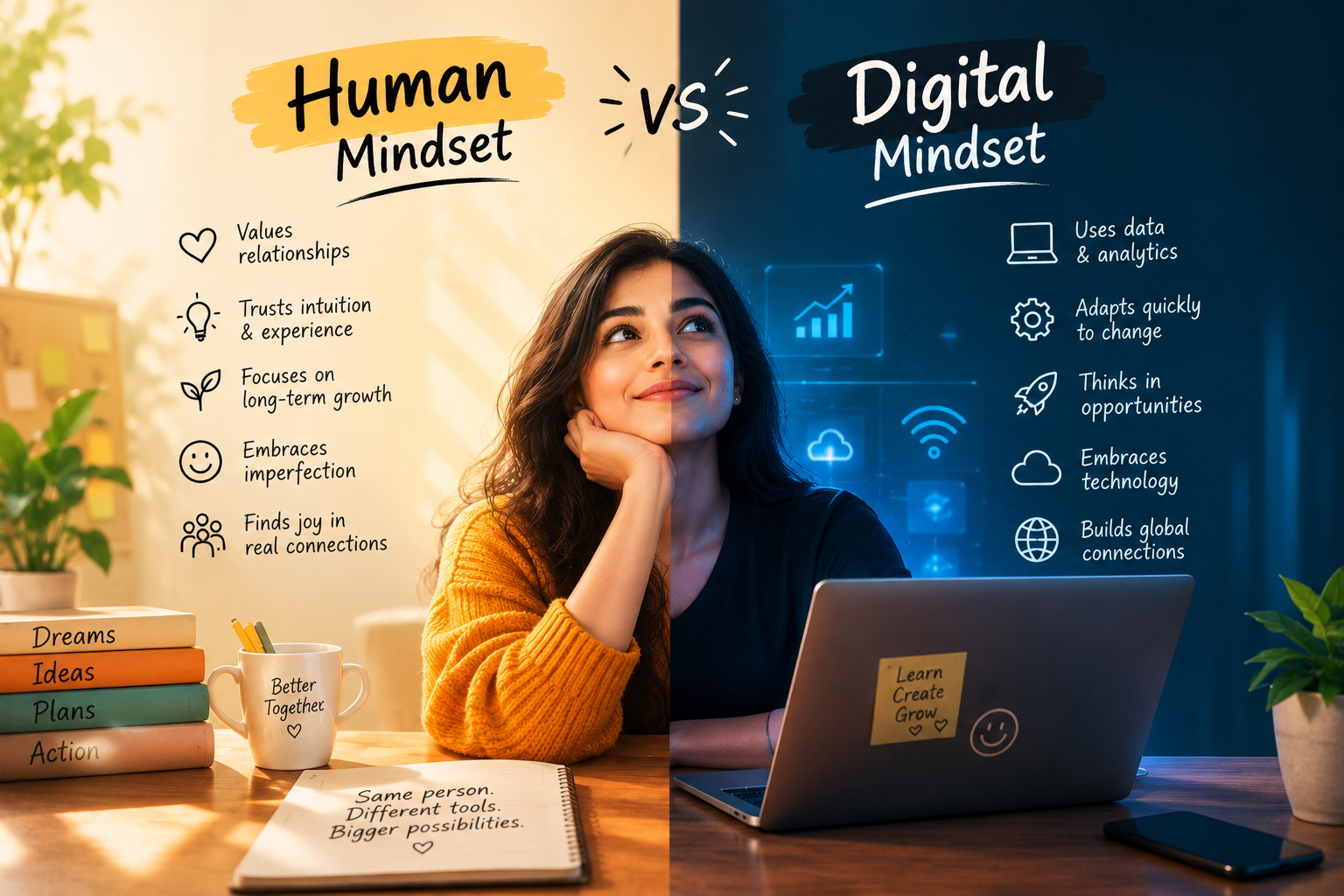
Human vs. Digital Mindset: Finding the Balance in a Changing World
Technology has changed the way we work, communicate, learn, and make decisions. Artificial intelligence, automation, data analytics, and digital platforms are becoming part of our everyday lives.
As technology becomes smarter, an interesting question arises:
Are we becoming more digital in the way we think, or are we simply using digital tools to make our human thinking better?
The answer lies in understanding the difference between a human mindset and a digital mindset.
What Is a Human Mindset?
Technology can process enormous amounts of information, but human intelligence has qualities that are difficult to replicate.
Empathy
Humans can understand emotions and respond to situations with compassion.
Creativity
People can connect seemingly unrelated ideas and create something new based on imagination and experience.
Critical Thinking
Humans can question information, consider different perspectives, and understand situations that may not have a clear answer.
Emotional Intelligence
Communication is not always about words. Tone, feelings, relationships, and context can influence how a message is understood.
Ethical Judgment
Technology can provide recommendations, but humans still need to consider whether a decision is responsible, fair, and appropriate.
What Is a Digital Mindset?
A digital mindset is the ability to use technology, data, digital tools, and continuous innovation to solve problems and identify opportunities.
It does not simply mean knowing how to use computers or social media.
A digital mindset means being comfortable with change and being willing to learn new technologies and approaches.
Someone with a digital mindset may ask:
- What does the data tell us?
- Can technology make this process faster?
- Can this task be automated?
- How can we improve the customer experience?
- What new digital opportunity can we explore?
A digital mindset encourages experimentation, adaptability, and continuous improvement.
Human Thinking vs. Digital Thinking
Human and digital mindsets approach problems differently.
Human mindset focuses on:
- Emotion
- Creativity
- Empathy
- Relationships
- Experience
- Intuition
- Meaning
Digital mindset focuses on:
- Data
- Technology
- Speed
- Automation
- Efficiency
- Innovation
- Scalability
At first, these approaches may seem completely different. But they do not have to compete with each other.
In fact, the strongest results often happen when they work together.
Where Humans Have the Advantage
Technology can process enormous amounts of information, but human intelligence has qualities that are difficult to replicate.
Empathy
Humans can understand emotions and respond to situations with compassion.
Creativity
People can connect seemingly unrelated ideas and create something new based on imagination and experience.
Critical Thinking
Humans can question information, consider different perspectives, and understand situations that may not have a clear answer.
Emotional Intelligence
Communication is not always about words. Tone, feelings, relationships, and context can influence how a message is understood.
Ethical Judgment
Technology can provide recommendations, but humans still need to consider whether a decision is responsible, fair, and appropriate.
Where a Digital Mindset Has the Advantage
Digital thinking provides powerful capabilities that can enhance human decision-making.
Speed
Digital tools can process information much faster than humans can manually.
Data Analysis
Technology can identify patterns and trends across large amounts of data.
Automation
Repetitive tasks can be automated, allowing people to focus on more valuable activities.
Scalability
Digital systems can help businesses serve larger audiences without increasing manual effort at the same rate.
Continuous Innovation
Digital technologies make it easier to experiment, test ideas, measure results, and improve processes.
The Problem With Choosing Only One
A completely human approach can sometimes ignore valuable data and technological opportunities.
On the other hand, relying entirely on technology can result in decisions that lack empathy, creativity, and human understanding.
Imagine a company using data to identify which customers are likely to stop using its service.
The technology can identify the customers.
But understanding why those customers are unhappy and deciding how to approach them requires human understanding.
This is where the two mindsets can complement each other.
The Future Is Human + Digital
The future of work is unlikely to be simply about humans competing against technology.
Instead, it will increasingly be about humans working with technology.
A marketer can use AI to analyze customer behaviour but use human creativity to develop the campaign.
A business leader can use data to identify a problem but use empathy to understand how the problem affects employees.
A designer can use digital tools to create ideas faster while relying on human creativity to decide what feels visually meaningful.
Technology can provide possibilities.
Humans provide purpose.
How to Develop a Digital Mindset Without Losing the Human Mindset
Developing a digital mindset doesn’t mean becoming completely dependent on technology.
It means learning how to use technology intelligently while maintaining human strengths.
Keep Learning
Digital technologies change quickly. Stay curious and continue learning new tools and skills.
Use Data, But Don’t Ignore Context
Numbers can reveal patterns, but they don’t always explain the complete story. Combine data with experience and human judgment.
Experiment
Try new tools and approaches. Digital thinking is strongly connected to experimentation and learning from results.
Protect Creativity
Don’t allow automation to replace original thinking. Use technology to support creativity rather than eliminate it.
Focus on People
Behind every data point, click, purchase, or conversion is a person. Understanding people should remain at the centre of every strategy.
Final Thoughts
The debate between human vs. digital mindset should not be about deciding which one is better.
It should be about understanding how both can work together.
The digital mindset gives us speed, data, automation, and new possibilities.
The human mindset gives us empathy, creativity, intuition, emotional intelligence, and purpose.
The businesses and professionals who succeed in the future will likely be those who can combine both.
Think like a human. Work with digital intelligence. Create with purpose.
Because the future isn’t about choosing between humans and technology.
It’s about making technology more human — and humans more capable through technology.
Written by Keerthi GK
Digital marketing is a continuous journey of learning, creativity, and innovation. As trends and technologies evolve, staying curious and adapting to change will always be essential for growth.
The future of digital marketing belongs to those who keep learning, dare to innovate, and turn every new trend into an opportunity to create meaningful connections.